Duct Sealing: Finding the Hidden Energy Loss in Your HVAC
Leaky ductwork wastes a significant share of conditioned air. Duct sealing, measured with a leakage test, is one of the few HVAC improvements with a verifiable result.
By AirDuctSanitizingServices.com Editorial Team · 8 min read · March 6, 2026
Leaky ductwork is one of the largest and least visible sources of energy waste in a home, and duct sealing is the repair that addresses it. The U.S. Department of Energy has long estimated that a significant fraction of conditioned air moving through a typical duct system escapes through joints, seams, and disconnected sections before it reaches the intended room. That loss shows up as uneven temperatures, longer system run times, and higher utility bills — and it is invisible without testing.
The leaks happen at predictable points. Duct connections at the air handler, branch takeoffs, boot-to-register transitions, and any joint inside a wall, attic, or crawlspace are the common culprits. Flexible duct sags where the inner liner separates from its connector; sheet metal joints pull apart where the sealant has dried and cracked. Because most ductwork runs through unconditioned spaces, the escaped air is not just lost — it is lost to an attic or crawlspace where it does no useful work.
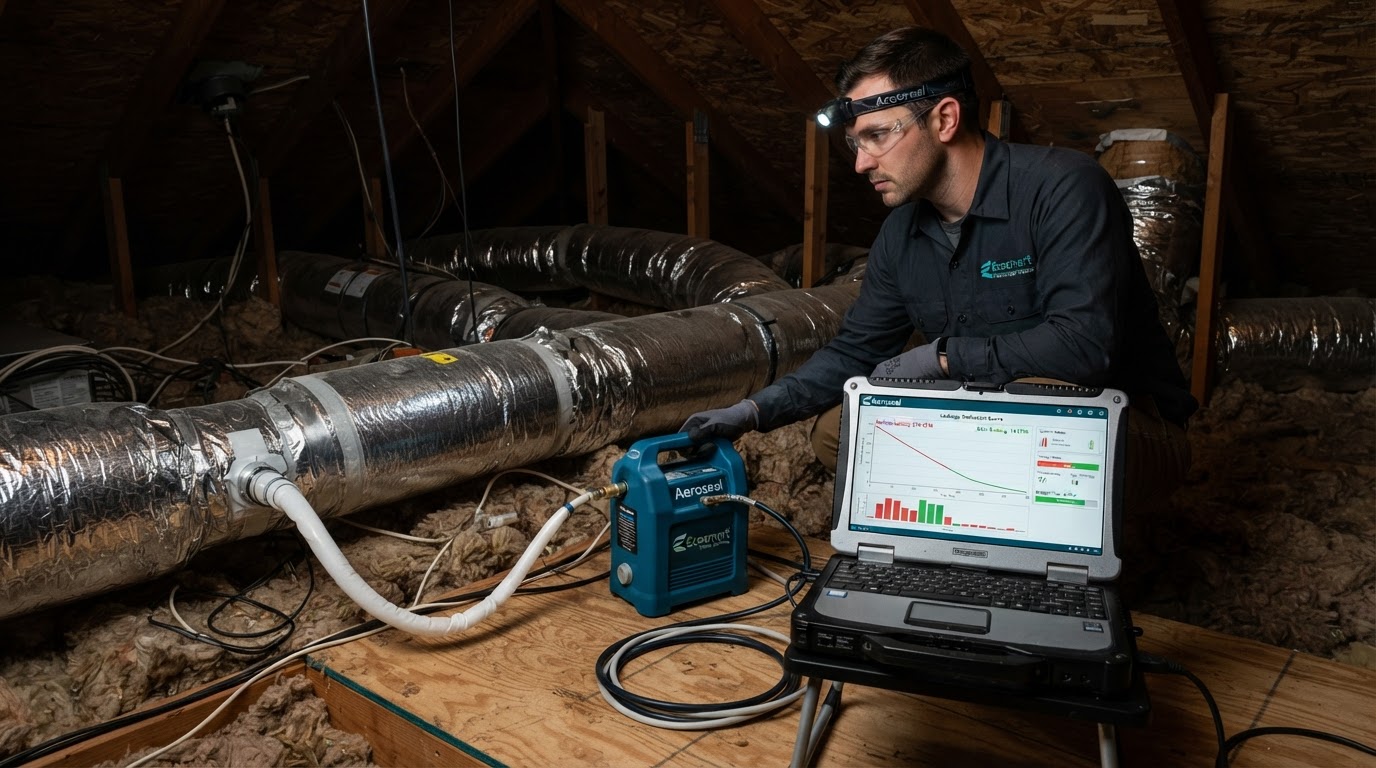
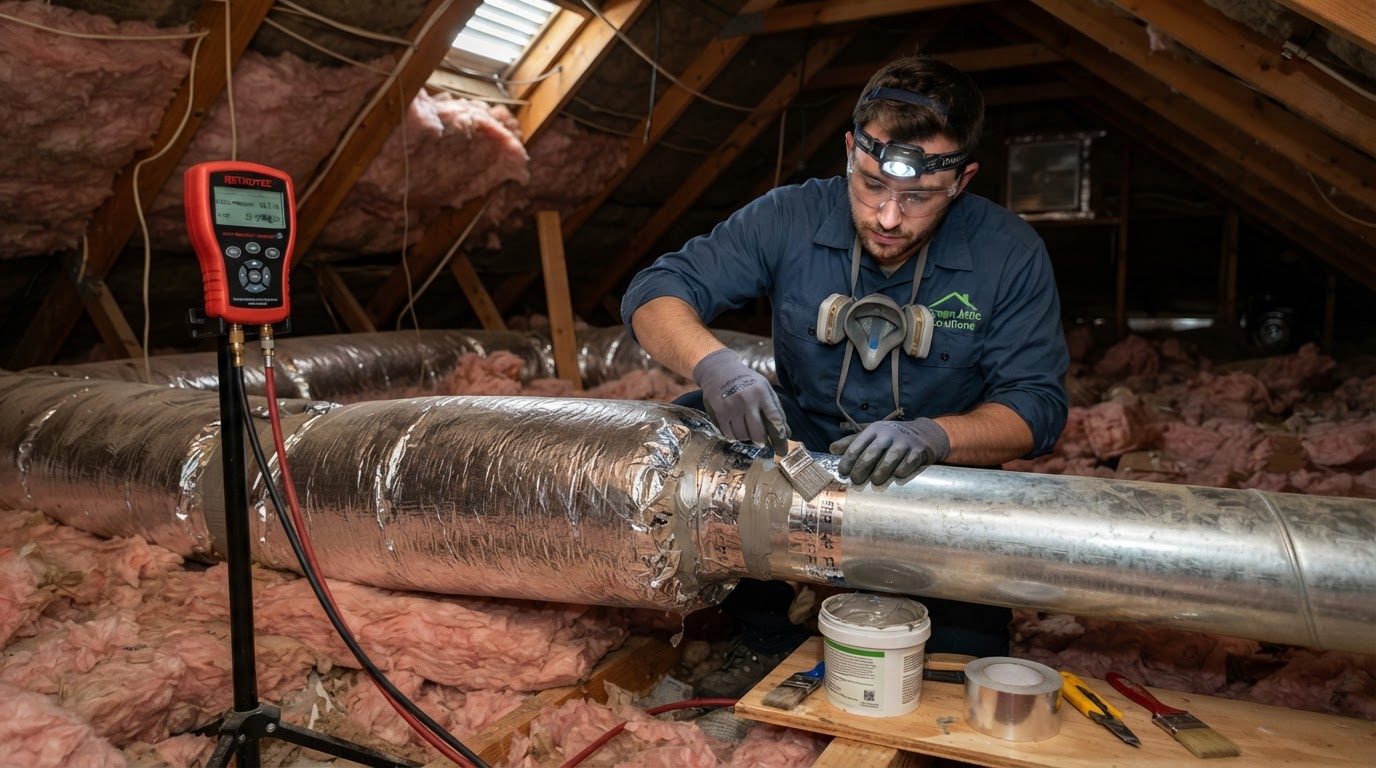
The first step in any honest duct sealing project is a measurement. A technician pressurizes the duct system with a calibrated fan and reads the leakage in cubic feet per minute at a reference pressure, typically 25 pascals. That number is the baseline. Without it, sealing is guesswork; with it, the work can be verified by re-testing after the repair and reporting the measured reduction. A provider who seals without measuring is asking you to pay for a result they never confirmed.
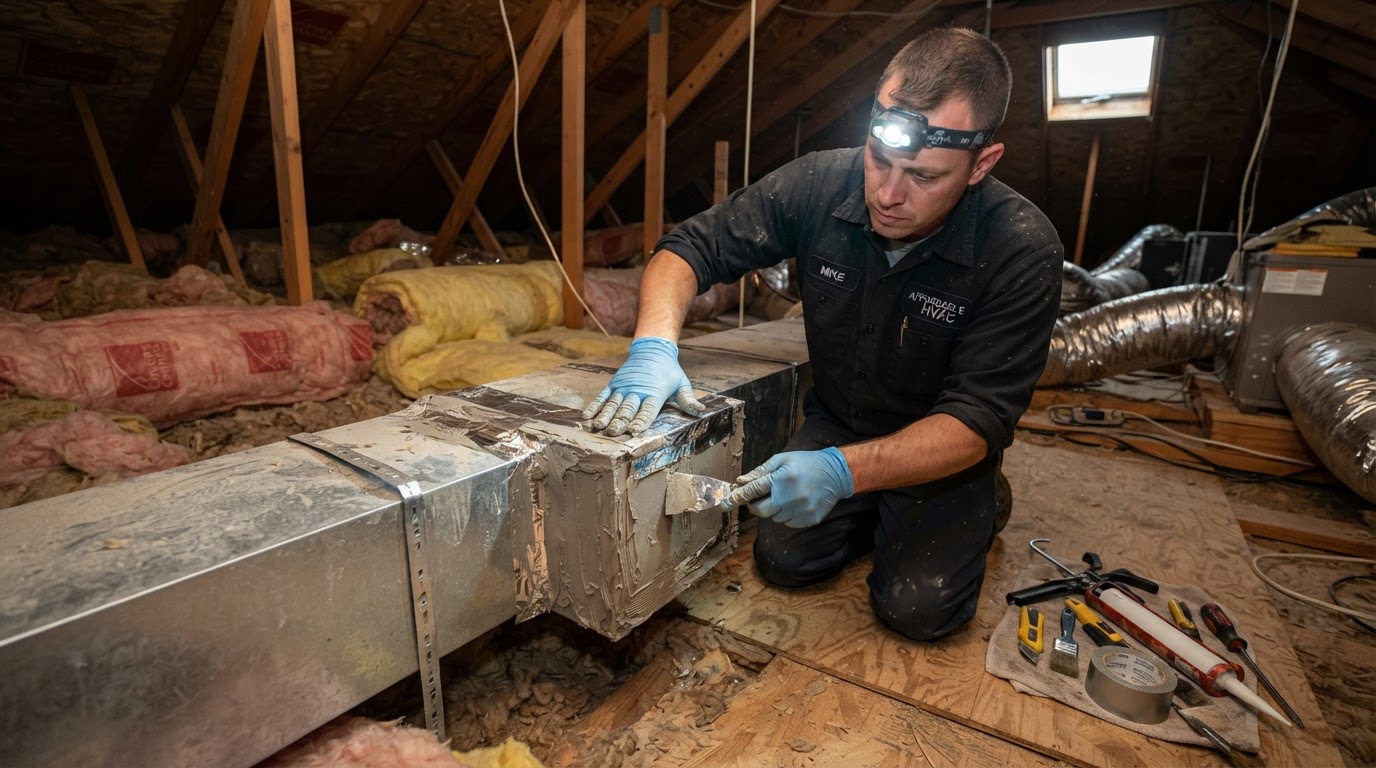
Accessible joints are sealed the durable way — with mastic paste and fiberglass mesh at large gaps, and foil tape rated for HVAC use, never cloth "duct tape," at seams. Aerosolized internal sealing, such as Aeroseal and similar systems, injects a vinyl-polymer mist into a pressurized duct; the particles are too large to deposit in the main airflow but lodge at the leaks where the airstream accelerates, building up and sealing the joint from the inside. The aerosol method is most valuable for leaks that are unreachable externally — joints inside walls, behind finished ceilings, and at boot connections.
What duct sealing does not fix is equally important. It does not replace a disconnected or crushed section of duct, it does not repair missing external insulation, and it does not clean the ducts — in fact, internal sealing is usually performed after a cleaning so the polymer bonds to a clean surface. A provider who quotes sealing for a duct that is physically disconnected is selling the wrong fix; the disconnected section needs to be reconnected and mechanically sealed first.
The comfort payoff is often the clearest benefit. Sealing the leaks that starved a distant bedroom of airflow restores even distribution; the system satisfies the thermostat sooner and runs less. In a humid climate, sealing also reduces the unconditioned attic or crawlspace air drawn into the return side through leaks, which lowers indoor humidity and the load on the coil. The energy and comfort effects compound: less lost air, shorter cycles, lower bills.
The practical path: start with a leakage test, repair the accessible joints with mastic and rated foil tape, use aerosolized sealing for the unreachable leaks, re-test to confirm the reduction, and address any missing insulation or crushed sections separately. Get the before-and-after CFM numbers in writing. Duct sealing is one of the few HVAC improvements with a measurable, verifiable result, and the verification is what separates a real repair from a promise — so insist on the measurement, and treat any quote without one as a reason to keep looking.