Measuring Dryer Vent Airflow: When a Cleaning Isn't Enough
Sometimes the duct is clean and the dryer still runs hot. A static-pressure or airflow check tells you whether the problem is the vent, the duct routing, or the dryer itself.
By AirDuctSanitizingServices.com Editorial Team · 5 min read · June 26, 2026
A clean dryer duct still has to move enough air. The manufacturer's venting limits — maximum equivalent length, number of elbows, and duct diameter — exist because the dryer's blower can only overcome so much static pressure. A run that violates those limits will underperform no matter how spotless the duct is.
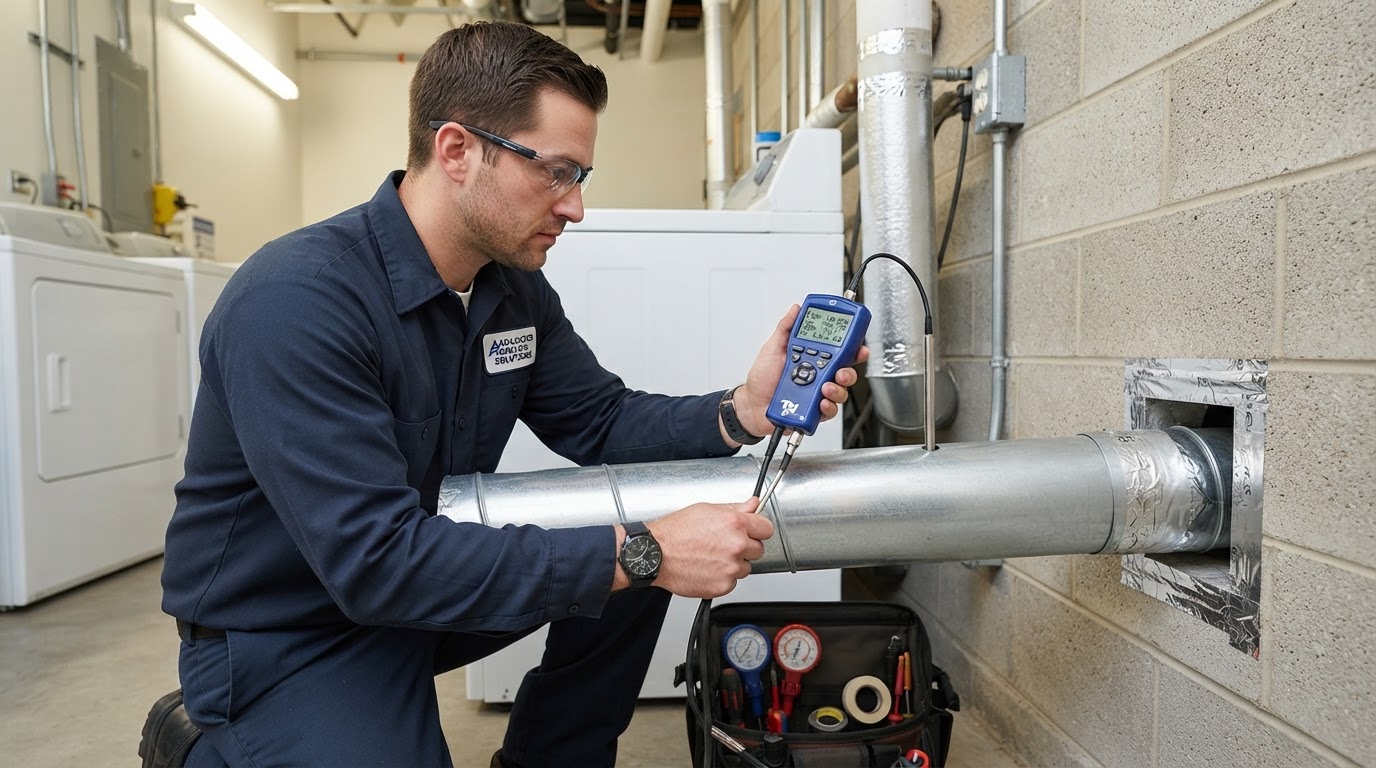
A technician can measure airflow at the exterior hood with an anemometer or check static pressure with a manometer at the dryer transition. The reading tells you whether the problem is residual restriction (clean more, replace a crushed section), an undersized or over-length run (reroute or upsize), or the dryer itself (a failing blower or blocked internal lint path).
Rigid metal duct with smooth interior walls and the shortest practical routing moves more air than corrugated flex at the same length. Every 90-degree elbow adds equivalent length; long horizontal runs accumulate lint faster than vertical ones.
If your dryer has been cleaned and still takes two cycles, do not assume the duct company missed something. Ask for the airflow reading. The data is what tells you whether the next step is a vent redesign rather than another cleaning.